Showing posts with label Ann Blockley. Show all posts

Sunday, 24 May 2015

Woodland Stream


Stream Through the Woods - Small
Mixed Media on Paper
14cm x 19cm (5.5" x 7.5")

These are my latest experiments with techniques from Ann Blockley’s Experimental Landscapes in Watercolour. The subject matter was inspired by a recent video workshop by David Dunlop (Studio Workshop 1 - Into the-Woods).

Stream Through the Woods - Large
Mixed Media on Paper
19cm x 28cm (7.5" x 11")

The scene is an amalgamation of five different photos of streams and footpaths through woodland. I worked on both pictures at the same time, but I am still quite surprised how similar they look because a lot of the scene is imaginary and I was not focusing on accuracy. My intention for these experiments is not to create finished paintings. They are trials of different techniques I may want to use in the future.

Sunday, 8 March 2015

The View From Porlock Weir

From Porlock Weir - Version 1
Mixed Media on Paper
27cm x 19cm (10.5" x 7.5")

Porlock Weir is a small village and harbour on the North Somerset coast. I visited it for the first time last November - the day before my sketching trip to Dorset (see Portland and the Chesil Beach). Elaine spent the weekend learning about upholstery techniques and I was left to entertain myself.

These pictures are of the view from Porlock Weir across Porlock Bay to Hurlstone Point and Bossington Hill.

I am continuing to experiment with the ideas from Ann Blockley's books and DVDs, but in these paintings I was also trying to channel some elements of Stewart Edmondson's style.

From Porlock Weir - Version 2
Mixed Media on Paper
27cm x 16.5cm (10.5" x 6.5")

When I am messing around with techniques, I tend to work on two (or more) versions of a subject at the same time. This gives me a backup in case one of the experiments goes badly wrong and also allows me to explore variations on the theme.

By the time they are finished, I usually have a definite favourite, but there are always good bits in both versions that I would like to combine.

In this case, I prefer the version at the top of the post but there are some good elements in the second version. The gouache sea was a mistake, but I like the patch of sunlight on the right of the hillside.

Sunday, 25 January 2015

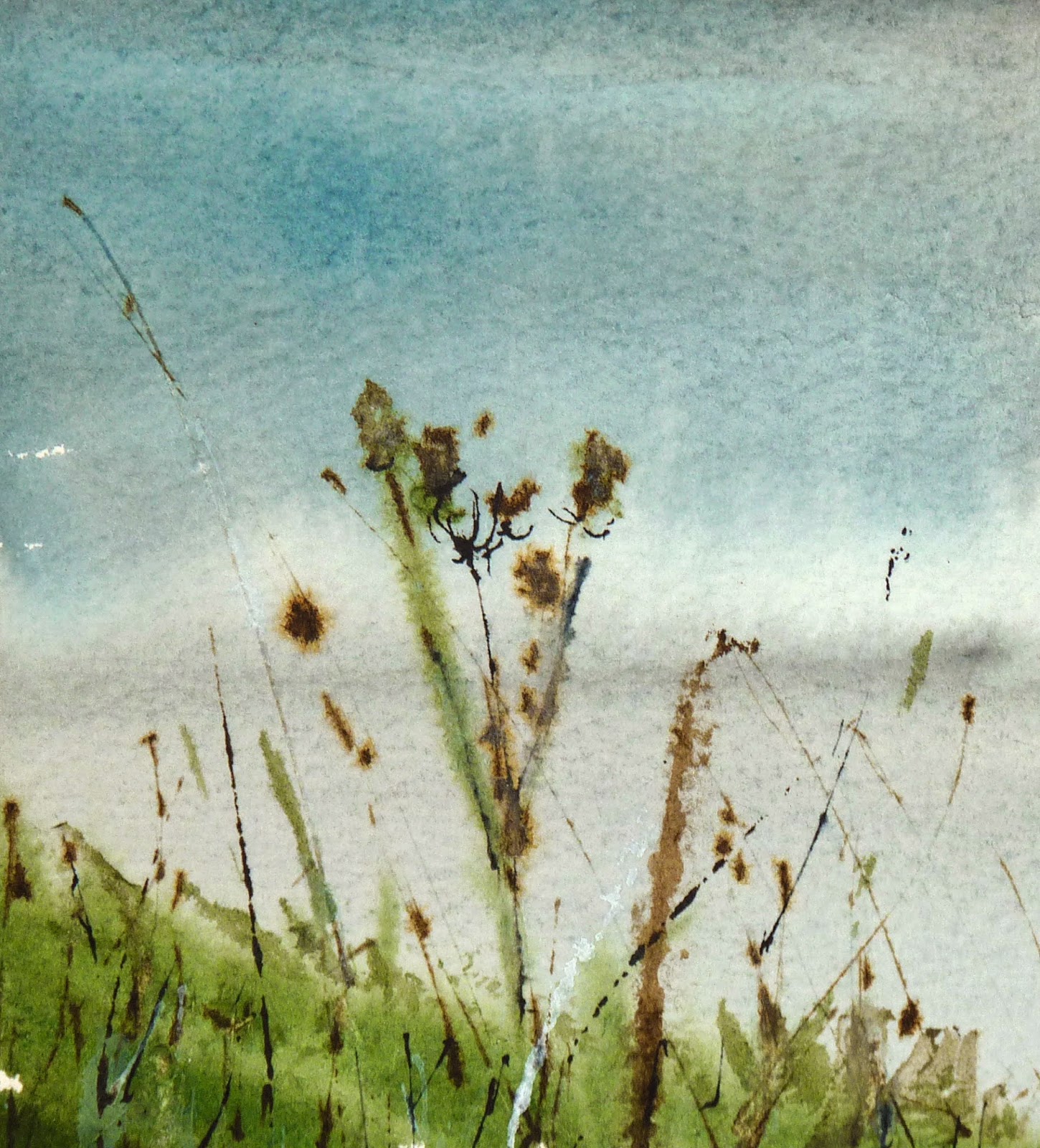
Teasels and Grasses

Coastal Path - Teasels and Grasses
Mixed Media on Paper
25cm x 18cm (10" x 7")

The Dorset coast is a wonderful place. This picture was inspired by the teasels and grasses on the cliff tops between Durlston Head and St Aldhelm's Head near Swanage.

I posted a similar subject last year (see Experiments with Acrylic Ink).

Both paintings started as experiments with techniques from Ann Blockley's Experimental Landscapes in Watercolour.

This latest piece was more experimental than the first. The initial wash of watercolour and acrylic ink went crazy when I covered it in cling film. The greens and browns were sucked along the folds of the cling film into the sky.

Teasels and Grasses - Initial Wash

It took some pondering to decide on the next step. In the end, the hint of a stalk of grass next to a large teasel head pointed me in the right direction.

I painted the sky in gouache (see Experiments with Gouache)  and used negative painting to establish the shapes of the foliage. I applied the gouache quite roughly to suggest the atmosphere of a cliff top on a blustery day.

Sunday, 10 August 2014

Experiments with Scraping

Between the Rocks
Watercolour on Paper
27cm x 17cm (10.5" x 6.75)

I am continuing to explore the different mediums and techniques from Ann Blockley's  “Experimental Landscapes in Watercolour” (see Experiments with Acrylic Ink and Experiments with Gouache). I tend to use these investigations as a warmup at the start of a painting session.

Scraping involves applying a layer of watercolour and partially scraping it off before it dries. It is a good technique for creating texture in things like tree bark, rocks and walls. You can use different tools to create different textures.

I've written about scraping before (see Scratching and Scraping), but it is a technique I've never mastered.

The picture at the top of this post is my third attempt at this scene. The first two were dreadful. Part of my problem is that Ann and other authors recommend using a creamy mix of paint. When I try this, the paint usually dries before I have achieved the desired effect, especially if I am working on a large area like the cliffs in this view.

In this version I painted an initial pale yellow and pink wash and after this was dry a thicker, but still relatively watery green wash.

I moved this wash around with the edge of an old plastic loyalty card to create the appearance of cracks and other textures in the rock. I was conscious of the need to keep my focus moving round the whole painting and not to focus on one area at the expense of the rest. As the wash started to dry it became easier to scrape it off completely to create highlights. The experience was more like sculpting than painting.

Sunday, 4 May 2014

Experiments with Gouache

Bluebells in Oversley Wood
Acrylic Ink and Gouache on Paper
10cm x 10cm (4" x 4")

Ann Blockley's recently published book - Experimental Landscapes in Watercolour contains a subsection called  "the versatility of gouache".

Gouache contains the same basic ingredients as watercolour paint, but the recipe is changed to make it opaque. In some brands this opacity may be achieved by adding chalk, but Winsor and Newton say
It is widely misunderstood that Gouache is opaque as a result of adding chalk or other such materials. The opaque colours within the Winsor & Newton Designers Gouache range are opaque due to the exceptionally high levels of pigmentation in the formulation.
This opacity allows you to paint light colours on top of dark - which is not possible with transparent watercolours.

I've used gouache before - in the painting of  Smeaton's Pier (see Making Corrections with Gouache) I included some gouache in the background wash to create a slightly misty effect and then used gouache to obscure and alter parts of the picture.

In Bluebells in Oversley Wood, I've used gouache to add details to the acrylic ink wash I posted last weekend (see Experiments with Acrylic Ink).

Rangali Sunset
Watercolour and Gouache on Paper
12cm x 17cm (4.75" x 6.75")

In Rangali Sunset, the majority of the sea and sky is watercolour. The reflection of the setting sun is a strip of pink gouache added to the wash. The sun is a circle of pink gouache added once the sky and sea had dried. The trees are dark watercolours painted over the lighter sky. The beach and huts are gouache painted over the trees.

I could paint a similar painting in pure watercolour, but it would require more careful planning. I would either have to paint the dark trees around the lighter beach and huts or paint the trees and then lift off some of the colour.

The experiments on this post are the only drawing and painting I've done this week because I've been trying to rest my hands and arms. The severity of the RSI (repetitive strain injury) symptoms has reduced and I am planning to start drawing again on Tuesday. The improvement seems primarily due to physiotherapy, but rest and anti-inflammatory medicines are playing their part.

Sunday, 27 April 2014

Experiments with Acrylic Ink

Teasels and Grasses – Durlston Head
Acrylic Ink on Paper
10cm x 11cm (4" x 4.5")

The pictures on this post are inspired by Ann Blockley's recently published book - Experimental Landscapes in Watercolour

The first major subsection is about acrylic inks. I've used them before, but this is the first time I've set out to paint pictures almost entirely in ink.

Tree on Old Hill
Acrylic Ink and Water-soluble Pencil on Paper
10.5cm x 10.5cm (4.25" x 4.25")

Tree on Old Hill is my first experiment. I applied strips of blue, white and green using the pipettes from the ink bottles and then spread the ink out with a wet brush. I drew the tree with Graphitint water-soluble pencils and sepia ink while the initial washes were still wet. I accidently splashed some water on to the top of the tree, so I dabbed this with a paper towel to create a cloud.

Bluebells in Oversley Wood - Step 1
Acrylic Ink on Paper
10cm x 10cm (4" x 4")

Bluebells in Oversley Wood is based on the impressions of a sunny springtime walk with Elaine, Paul, Wendy and their old dog Jack. I've let white, yellow, green and blue inks merge on the page and while they were still wet drawn tree shapes with sepia and white ink. This looks more like an underpainting than a finished work. The next subsection in Ann’s book is “the versatility of gouache”, so I will finish it with some gouache during the week.

The colours in the first two experiments are vivid, but Ann reveals acrylic inks can be used to produce more subtle colours. In the third experiment, I diluted the inks with lots of water and toned them down with Payne's grey and sepia inks. I drew the teasels and grasses with a variety of implements as the washes dried.

The RSI (repetitive strain injury) symptoms I've been suffering from haven’t changed significantly. Typing seems to be the main trigger. I've started to paint again this weekend and plan to do some drawing during the week.

Sunday, 1 December 2013

Early Autumn on the Kennet and Avon


Early Autumn on the Kennet and Avon 1
Watercolour and Acrylic Ink on Paper
27cm x 18cm (10.5" x 7")

At the end of October, Elaine and I had a holiday on the peaceful Kennet and Avon canal with Paul, Wendy, and their dog Alfie (see Canal Sketches).


The last day was glorious; the sun shone and the leaves on the tress had just started to change to their autumn colours.


I saw a row of trees that I wanted to paint, but only had time to take a couple of quick snapshots as we chugged past at 4 miles an hour - fortunately, Paul was driving or the photos would be even more hurried.


Yesterday, I realised the trees would be a good subject for an exercise suggested by Ann Blockley in Watercolour Textures. Ann recommends painting multiple versions of the same (or similar) subjects using a variety of different techniques.

Early Autumn on the Kennet and Avon
Preliminary Sketch
Graphite Pencil on Paper
27cm x 18cm (10.5" x 7")

The painting at the top of the post is my first attempt. I started by painting wet in to wet washes on wet paper. The washes blended into each other resulting in a soft focus impression of the scene. I was tempted to leave it like this, but after the washes dried, I couldn’t resist adding some sharper details to the trees and banks.

Early Autumn on the Kennet and Avon 1
Initial Wash
Watercolour and Acrylic Ink on Paper
27cm x 18cm (10.5" x 7")

Over the next couple of weeks, I am planning to paint a few more versions of this scene.

Sunday, 2 December 2012

Scratching and Scraping

Winter Twigs
(Based on Geoff Kersey's Trees, Woodlands and Forests)
Watercolour on Paper
18cm x 15cm (7" x 6")

This is my interpretation of another demonstration from Geoff Kersey's third programme about “Trees, Woodlands and Forests” on The Painting and Drawing Channel.

In this demonstration, Geoff painted a dark background and then used a craft knife to scrape the branches and twigs out of the wet paint. He finished by continuing the branches on the white paper.

Timing is everything with this technique. If you scrape too early, the paint fills up the line. If you leave it too late the paint dries and will not scrape out in the same way.

Geoff used the craft knife to create a variety of line thicknesses, but I found it easier to use a pointed piece of plastic to scrape out the thicker lines. This is a tool recommended for the technique by Ann Blockley in her book “Watercolour Textures”.

Ann differentiates between the techniques of scraping (removing wet paint) and scratching (removing dry paint). Scraping wet paint creates the types of marks shown in the picture on this post.  Scratching off dry paint leaves a bright white highlight and requires a delicate touch to avoid gouging chunks out of the paper.

Sunday, 19 August 2012

The Wild Wood

Wild Wood 3
Mixed Media on Paper
18.5cm x 12cm (7.25" x 4.75")

Recently I bought Watercolour Textures by Ann Blockley because of a recommendation on Jane Minter’s blog (http://janeminterssketchbook.blogspot.co.uk/).

The book is about creating textural effects using watercolour paint and a variety of other materials. Some of the techniques create actual physical texture by using gesso, texture paste or collage. Other techniques create the illusion of texture by manipulation of the paint.

The pictures on this post are the result of experimenting with some of the ideas.

Wild Wood 2
Mixed Media on Paper
19cm x 13.5cm (7.5" x 5.5")

I started the first picture by covering the paper with gesso and then with washes of blue and various greens. While they were wet, I added some sepia acrylic ink.

I dropped in more ink than I intended and it spread out wildly, so I used a colour shaper to tease it into the tree shapes. (What is a colour shaper? - A paintbrush with a rubber tip instead of a brush. Why did I buy one? - I can’t remember, but they are quire handy for jobs like this.)

Colour Shapers

The result was unexpectedly satisfying, so I messed around with the technique in the second and third paintings.

Wild Wood 1
Mixed Media on Paper
17cm x 13cm (6.75" x 5")

Once the initial washes were dry, I added some blue pastel and gouache to reinforce the skyholes and finished the pictures by suggesting a foreground.