Showing posts with label SketchingNow. Show all posts

Sunday, 8 June 2025

Illustrated Journaling


Rudolf
Watercolour & Ink
Stillman & Birn Alpha Series Sketchbook
14.0 x 17.8cm cm (5.5" x 7.0")


An illustrated journal is a diary in which you record your life in both words and pictures. Liz Steel (SketchingNow) and Danny Gregory (Sketchbook Skool) both keep and recommend illustrated journals. 

No. It's a Pen Knife!
Watercolour & Ink
Stillman & Birn Alpha Series Sketchbook
14.0 x 17.8cm cm (5.5" x 7.0")

Until now, I haven’t included text with my sketches because my main reason for sketching is to practice drawing and painting. I wanted to create perfect little pictures, not to document my life.

Doris Free Weekend
Watercolour & Ink
Stillman & Birn Alpha Series Sketchbook
14.0 x 17.8cm cm (5.5" x 7.0")

This year, I’ve embraced the addition of text. My hope is it will make me less precious about creating pristine sketches. This will take the pressure off starting a drawing and result in me sketching more frequently. I also enjoy writing, so it is a welcome addition.

Pencil Full Of Lead
Graphite Pencil
Stillman & Birn Alpha Series Sketchbook
14.0 x 17.8cm cm (5.5" x 7.0")

I’m using a small sketchbook; each page is only 8.9cm x 14.0cm (3.5″ x 5.5″). It’s smaller than I enjoy using, but the benefits are it’s small enough to fit in a pocket and to go unnoticed when it’s in use. The small size should also help me to stop fussing over details.

Icing
Ink
Stillman & Birn Alpha Series Sketchbook
14.0 x 17.8cm cm (5.5" x 7.0")

 I’m also painting over the middle of the double page spread. This is another strategy to be looser and to reduce the expectation that each sketch needs to be faultless. You have to accept less than perfection when you’re drawing and painting over a fold.

Sunday, 11 August 2024

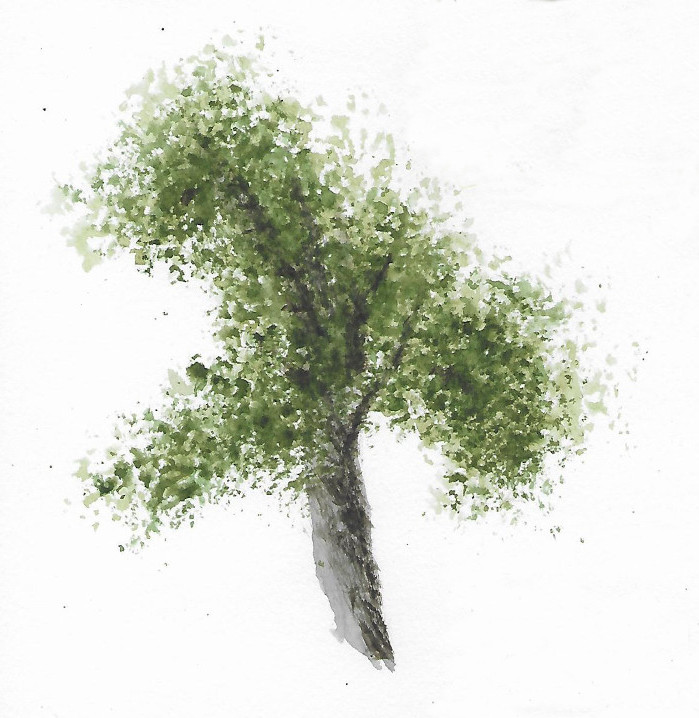
Distant and Background Trees

Background Trees - Claudia Nice
Watercolour & Ink
Stillman & Birn Beta Series Sketchbook
11cm x 9cm (4.5" x 3.5")

Distant and Background Trees are the sixth and seventh topic in the Tree Techniques chapter of Creating Textures in Pen & Ink with Watercolor by Claudia Nice. It’s a few months since I’ve picked up Claudia’s book. An exercise from Liz Steel’s SketchingNow Watercolour on Location course inspired me to return. By chance, I’ve picked it up at almost the same point as I left off.

In an exercise about common landscape elements, Liz suggests studying how other artists paint and draw the subject. The first topic on the list is trees, providing the perfect opportunity to revisit Claudia's book.

Distant Trees - Claudia Nice
Watercolour
Stillman & Birn Beta Series Sketchbook
15cm x 14cm (6" x 5.5")

I made some notes about Claudia’s treatment of distant and background trees and tried to copy a couple of her examples. 

Middle Distance Trees - John Lovett
Watercolour & Ink
Stillman & Birn Beta Series Sketchbook
14cm x 11cm (5.5" x 4.5")

I also looked at advice from John Lovett. I studied his suggestions about trees in Textures, Techniques & Special Effects for Watercolor and Getting Started and tried to copy some of his examples.

Tree - John Lovett
Watercolour
Stillman & Birn Beta Series Sketchbook
15cm x 14cm (6" x 5.5")

I’m pleased to get back to Claudia’s book and intend to continue learning from her content.

Sunday, 21 July 2024

SketchingNow – Edges


Cakes – Hard v Soft Edges
Watercolour & Ink
Stillman & Birn Beta Series Sketchbook
14.0 x 20.3cm cm (5.5" x 8.0")

In March, I joined a group run through of Liz Steel's SketchingNow Edges course. I then fractured my shoulder and couldn't sketch for over a month, so I finished way behind the rest of the group. 

Woodchester Park Boathouse
Watercolour & Ink
Stillman & Birn Beta Series Sketchbook
14.0 x 20.3cm cm (5.5" x 8.0")

(If you watch The Crown, you may recognize this building as the Gordonstoun school changing rooms.)

The Edges course is about creating depth and interest in your sketches by developing an understanding of edges. This involves recognizing whether the edges you see are a change in plane or just a change in colour and whether the edges are hard or soft or strong or weak. Once you understand the edges you are seeing, you can then decide how to represent them and manipulate them to make your sketches more exciting. There are four lessons each with an indoor and outdoor exercise.

Fruit Bowl
Watercolour & Ink
Stillman & Birn Beta Series Sketchbook
14.0 x 20.3cm cm (5.5" x 8.0")

I’ve done the course before in 2018 (see SketchingNow Edges), but I've learned a lot more this time through. 

Local Larder
Watercolour & Ink
Stillman & Birn Beta Series Sketchbook
14.0 x 20.3cm cm (5.5" x 8.0")

As a next step I've joined a group run through of Liz's SketchingNow Watercolour on Location course  which started on the 19th of June, but I'm already behind and rushing to catch up because of recovering from this injured shoulder.

Dresser
Ink
Stillman & Birn Beta Series Sketchbook
20.3 x 14cm cm (8.0" x 5.5")
You can see a few more sketches in a video on my YouTube channel SketchingNow Edges - What Have I Learnt?

Sunday, 21 April 2024

A New Watercolour Palette for Sketching

New Palette
Ink and Watercolour
Stillman & Birn Alpha Series Sketchbook
18cm x 18cm (7" x 7")

This is my new watercolour palette. The sketch is in the style of the colour charts Liz Steel does of her palettes (see CURRENT PALETTE – JAN 2020 by Liz Steel).

I needed a new palette because I’ve been using the lack of a suitable palette as an excuse for not sketching outdoors. I'm following Liz Steel's SketchingNow courses, so I've decided to try a palette more like hers. The colour selection is a mixture of paints I use in my main palette and paints Liz uses in her courses - like Potter Pink and Monte Amiata Natural Sienna.

Ready To Go

I've filled only one side of the pans because I'm trying a simplified version of ramp filling - which is explained in this blog post (The advantages of only partially filling watercolour pans from tubes by Jane Blundell). The idea of ramp filling is instead of having to jab into the paint and damaging the point of your brush, you can just swipe across.

There is a video with more details about setting up the pallet on my YouTube channel (https://youtu.be/7UqQuG_4VyY).

Sunday, 10 March 2024

SketchingNow – Watercolour


River Arrow
Watercolour and Ink
Moleskine A4 Watercolour Album

Since January, I’ve been participating in a Live Version of Liz Steel’s SketchingNow Watercolour course.  I've taken the course previously in 2019. You can see some of my sketches from then in these posts:

House Plant
Watercolour and Ink
Moleskine A4 Watercolour Album

Liz doesn't teach a traditional approach to watercolor. She uses it in a quicker and more spontaneous way, which lends itself to sketching on location. The course is structured so you can work through it at your own pace, but this year she ran a live version in which you work through the lessons with a group and Liz hosts a weekly live stream. 

Vegetables
Watercolour and Ink
Moleskine A4 Watercolour Album

Working through the course with a group has been motivating and adds an extra bit of encouragement to do the exercises. Seeing other people's work and hearing about what they've learned and found challenging is also helpful. 

Butcher Hill’s Lane
Watercolour and Ink
Moleskine A4 Watercolour Album

I'm building up some sketching momentum and this has encouraged me to join a group run through of Liz's Edges course which starts in mid-March. This is in preparation for her Watercolor on Location course which starts in June.

Still Life
Watercolour and Ink
Moleskine A4 Watercolour Album

I am studying Ian Roberts' YouTube videos (Ian Roberts Mastering Composition) in parallel to working on Liz's exercises. Most of these sketches have been influenced by his teaching on composition and shadows.

You can see a few more sketches and hear a bit more about my experiences with the course and my plans to develop my sketching skills on my YouTube channel SketchingNow Watercolour - What Have I Learnt?.

Sunday, 17 September 2023

More Recent Sketches

Aloe Vera
Watercolour
Stillman & Birn Alpha Series Sketchbook
20.3cm x 14cm (8.0" x 5.5")

Sorry for the lack of posts. Starting a YouTube channel (MarkBatemanArt) has distracted me from drawing, painting and blogging.

Prawn and Couscous Salad
Ink and Watercolour
Stillman & Birn Alpha Series Sketchbook
14.0cm x 20.3cm (5.5" x 8.0")


Once a week, I’ve been sketching from life. A lot of these have been based on exercises from Liz Steel’s SketchingNow Edges.

Gift Box
Ink and Watercolour
Stillman & Birn Alpha Series Sketchbook
14.0cm x 20.3cm (5.5" x 8.0")

This lovely little decorated box was made by Wendy.

Tea, Biscuits and a Seaview
Ink and Watercolour
Stillman & Birn Alpha Series Sketchbook
14.0cm x 20.3cm (5.5" x 8.0")

At the beginning of the summer, Elaine, Doris and I had a pleasant few days at the Talland Bay Hotel in Cornwall. These are the tea making facilities (and biscuits) from our room. I painted them as Doris recovered from a blistering hot day on the coastal path.

Father's Day Fern
Watercolour
Stillman & Birn Alpha Series Sketchbook
20.3cm x 14cm (8.0" x 5.5")

The aloe vera at the top of the post and this fern were Father’s Day presents from Doris. I've no idea where she got the money from - best not to ask.

Sunday, 18 June 2023

Recent (And Not So Recent) Sketches


No Flat Roads
Ink and Watercolour
Stillman & Birn Alpha Series Sketchbook
14.0 x 20.3cm cm (5.5" x 8.0")


Before Christmas, I realised I wasn’t drawing and painting from life very much, so I started doing an exercise a week from Liz Steel's SketchingNow Foundations

Quick Sketches Still Count
Ink and Watercolour
Stillman & Birn Alpha Series Sketchbook
14.0cm x 8.9cm (5.5" x 3.5")

These are a few of the sketches I’ve created since then. 

Palette
Ink and Watercolour
Stillman & Birn Alpha Series Sketchbook
14.0 x 20.3cm cm (5.5" x 8.0")

This is at least the third time I've taken the course. Not all the sketches have been successes because I am a bit out of practice and I am challenging myself to tackle difficult subjects from taxing angles.

What's in my Pocket?
Ink and Watercolour
Stillman & Birn Alpha Series Sketchbook
20.3 x 14cm cm (8.0" x 5.5")

My new YouTube channel (https://www.youtube.com/@MarkBatemanArt ) is taking up a lot of time, but I am still managing at least one sketch a week.

Over the Fence
Ink and Watercolour
Stillman & Birn Alpha Series Sketchbook
20.3 x 14cm cm (8.0" x 5.5")

Sunday, 28 March 2021

Drawing and Painting the Landscape – Drawing Games

Jackdaw
Drawing Games - Drawing and Painting the Landscape

Water-Soluble Graphite on Paper
39.5m x 56.5cm (15.5" x 22.25")

There didn’t seem to be any instructions for Lesson 22 of Drawing and Painting the Landscape by Philip Tyler. The spirit of the lesson is experimentation with a suggestion to use different techniques and media to reveal the different textures and layers in the landscape – which resonates with one of the lessons from Liz Steel’s SketchingNow – Edges class.

The seemed like an extension to the Making a Mess lesson (see Drawing and Painting the Landscape - Making a Mess). I ended up playing only two different games, but I played each multiple times and they both took me away from my normal approach to drawing.

For this first set of drawings, I used the water-soluble graphite block (ArtGraf Tailor Shape) I enjoyed so much in the Making a Mess lesson. 

The Mouth of the Dart
Drawing Games - Drawing and Painting the Landscape

Water-Soluble Graphite on Paper
39.5m x 56.5cm (15.5" x 22.25")

Using the water-soluble graphite is like a mixture of drawing and watercolour painting. In this drawing of the mouth of the Dart, I used different marks to convey the different layers in the landscape. The sky is horizontal marks and horizontal brushstrokes. The sea is vertical marks and vertical brushstrokes. The background hills are two layers of light swirling marks and swirling brushstrokes. The middle ground is more of the same but with more graphite and some Conté crayon marks. The foreground is much darker marks with a lot of additional Conté crayon marks.

The second set of drawings are quite different, so I will post them in a second post.

Sunday, 26 January 2020

Glass


Kilner Jar
Ink and Watercolour
Moleskine A4 Watercolour Album
297mm x 210mm (11.69" x 8.27")

Sometimes it’s difficult to summon the enthusiasm to draw something else from around the house. When this happens, it's useful to have someone else suggesting interesting or unusual subjects - it's one less thing to procrastinate about. Creating Textures in Pen & Ink with Watercolor by Claudia Nice provides a useful list of prompts.

Elaine gave me the book as a Christmas gift. The first chapter is about materials and the second explains basic texturing techniques. In the remaining chapters, Claudia describes the techniques she uses to render a variety of surfaces. For each topic, she provides examples that are primarily ink drawings with a little bit of watercolour to tint them and other examples which are primarily watercolour paintings with a little bit of ink to add definition. Chapter 3 is called "The Look of Transparency" and Glass is the first subject.

Jar and Bottle
Watercolour and Ink on Paper
280mm x 190mm (11" x 7.5")

The green jar and pink bottle is predominantly watercolour, the Kilner jar is predominantly an ink drawing and the vinegar bottle uses my current sketching technique – heavily influenced by Liz Steel's SketchingNow courses.


Condiment
Ink and Watercolour
Stillman & Birn Alpha Series Sketchbook
14.0cm x 20.3cm (5.5" x 8.0")

I need to be more patient building up textures and shading in ink. This is something I will work on with the next subject - Eyes.

Sunday, 1 September 2019

Drawing and Painting the Landscape – Cubes


The Queen and Albert
Watercolour and Ink
Moleskine A4 Watercolour Album
297mm x 210mm (11.69" x 8.27")

Chapter 3 of  Drawing and Painting the Landscape by Philip Tyler is about perspective. The chapter begins with simple perspective (see Drawing and Painting the Landscape – Simple Perspective). Lesson 8 continues the topic by looking at the impact of perspective on cubes and objects that are at an angle to our line of sight or inclined either uphill or downhill.

There isn’t a clearly defined exercise, so I drew this view of the cubic Queen and Albert Bed and Breakfast in Stratford, Ontario from a photo I took when Elaine and I stayed there in June 2011.

I also took the opportunity to practice the skills I recently picked up from Liz Steel’s SketchingNow Watercolor course  (see SketchingNow Watercolor (Lessons 1 to 2) and SketchingNow Watercolor (Lessons 3 to 4)).

Sunday, 25 August 2019

SketchingNow Watercolor (Lessons 3 to 4)

Merry Fisher
Watercolour and Ink
Moleskine A4 Watercolour Album
297mm x 210mm (11.69" x 8.27")

I’ve completed Liz Steel’s SketchingNow Watercolor course. Lessons 3 and 4 have the same well-balanced mix of theory videos, demonstrations, handouts and exercises as the first half of the course (see SketchingNow Watercolor (Lessons 1 to 2)).

Master Palette
Watercolour and Ink
Moleskine A4 Watercolour Album
297mm x 210mm (11.69" x 8.27")

Lesson 3 is about Using Colour. Liz offers a pragmatic explanation of colour theory and suggests creating a master palette of your favourite colour mixes. She hypothesises you make sketching easier by using a palette of tried and tested mixes instead of trying to match a specific colour while you are out in the field. She also recommends using colour and value studies in preparation for a sketch as a useful discipline for novices.

Colour and Value Studies
Watercolour, Graphite Pencil and Ink
Moleskine A4 Watercolour Album
297mm x 210mm (11.69" x 8.27")

The assignments for this lesson are to create a master palette and to try some colour and value studies. I enjoyed the exercises. Some of the mixes in my master palette were experiments rather than my usual combinations, but I learnt from this and will adopt some of these new blends. I am also going to change some of the paints and will repeat the exercise using the new colours.

Lesson 4 is about Sketching with Watercolour. Liz discusses the traditional watercolour approach of working from light to dark and suggests starting with the darks as an alternative.

The assignments for the lesson are:

  • Paint some cakes either from life or Liz’s photo reference. You can decide whether to work from light to dark, or to start with darks, or to mix things up. I chose to use Liz’s photo and to start with the darks.
  • Sketch something you enjoy sketching, but use a different approach to your usual. It could be starting with darks, working wet or layering. I sketched the boat from a photo I took during Elaine’s, Doris and my recent holiday in Dartmouth. I chose to start with the darks and to work wet. I’m pleased I stopped when I did. My original intention was to add a tint to the background, but it doesn’t need it.

Liz's Cakes
Watercolour and Ink
Moleskine A4 Watercolour Album
297mm x 210mm (11.69" x 8.27")

The last section of the course is another review of sketches. There are also additional theory and demo videos. There is a final exercise to re-do a sketch you did prior to the course and to notice how different your approach is and how much you have improved.

I’ve learnt a lot and acquired some ideas I will incorporate into both my sketching and more considered watercolour paintings.

Sunday, 14 July 2019

SketchingNow Watercolor (Lessons 1 to 2)

Summer Collection 2019 (and 2018 and 2017)
Watercolour and Ink
Moleskine A4 Watercolour Album
297mm x 210mm (11.69" x 8.27")

I’ve reached the half way point in Liz Steel’s SketchingNow Watercolor course.

Liz’s premise is that watercolour sketching (particularly on location) requires a different technique to studio painting. Her focus is on a direct approach, trying to get the desired colours and effects first time, rather than the more traditional approach of gradually building up layers of washes.

In common with her other courses. there is lots of well thought out video content and exercises.

The first lesson is about controlling water and focuses on three types of washes:

  • Watery - a lot of water for the amount of pigment.
  • Juicy - a generous load of pigment for the amount of water.
  • Pasty - mainly pigment with a little bit of water.

The second lesson is about

  • Colour mixing: how to mix two colours
  • Layering: putting one wash over another dried wash
  • Working wet: mixing paints on the paper while they are wet

The third week is primarily a review of sketches from Lessons 1 and 2. There are also some additional theory videos, an extra demo, and an exercise to paint some of your wardrobe – the clothes not the cupboard.

I’ve learnt a lot, some of it stuff I already knew, but to which I wasn’t paying sufficient attention. Perhaps the most important lessons for me are: be generous, paint with confidence (regardless of whether this is warranted or not), and paint every day.

Being generous might seem like a strange comment. I'm referencing a French film (probably Leon) in which a character observes that only generous people can make good sandwiches (or something like that). I think the sentiment holds true for many things - including watercolour painting.

Sunday, 30 June 2019

Drawing and Painting the Landscape – Simple Perspective


Books in Perspective
Simple Perspective - Drawing and Painting the Landscape
June 2019
Ink and Watercolour
Stillman & Birn Alpha Series Sketchbook
18.5cm x 21.5cm (7.25" x 8.5")

Chapter 3 of Drawing and Painting the Landscape by Philip Tyler is about perspective. He starts the chapter by offering some pragmatic advice:

Linear perspective gives you an understanding of how objects behave in space. It is not a set of hard and fast rules that have to be adhered to, but a little bit of knowledge will go a long way and will certainly help you create a convincing depth in your landscapes, and help clarify how man-made objects, like buildings, recede and converge, making them seem more three-dimensional.

Lesson 7 provides some exercises on simple perspective. It begins with a diagram of a road in single point perspective with a line of equally spaced lampposts running off into the distance. This diagram illustrates a horizon line, a single vanishing point, and how to equally space objects in perspective.

Single Point Perspective
Simple Perspective - Drawing and Painting the Landscape
June 2019
Graphpite Pencil
Stillman & Birn Alpha Series Sketchbook
21.5cm x 18.5cm (8.5" x 7.25")

Philip then uses photos of piles of books to illustrate multiple vanishing points on the same horizon line and the impact when the books are not lying flat on the table.


My sketch reminded me of the setup from one of Liz Steel's Sketching Now - Foundations exercises (see May 2016 Sketches and Welcome Back)

I’m pretty pleased with the painting in this sketch, but I have a tendency to overwork. I’ve just started taking Liz’s SketchingNow Watercolour. During the use the course, I’m hoping to learn techniques and strategies to get the effects I want more consistently.

Sunday, 19 May 2019

Drawing and Painting the Landscape – Measured Drawing

View Towards Gatcombe Farm
Measured Drawing - Drawing and Painting the Landscape
April 2019
Ink
Stillman & Birn Alpha Series Sketchbook
21.5cm x 18.5cm (8.5" x 7.25")

In Lesson 5 of Drawing and Painting the LandscapePhilip Tyler introduces some techniques to accurately draw a picture to scale based on sight measuring and angle checking. This involves adopting the stereotypical pose of the artist using a pencil in an outstretched arm to estimate the relative size of objects, measure angles and to check alignments.

The approach is similar to those explained in other sources including The Urban Sketcher by Marc Taro Holmes (Citizen Sketcher) and Liz Steel's SketchingNow Foundations course. This isn't surprising because there are a limited number of ways to address the challenge of translating a three-dimensional landscape into an accurate two-dimensional drawing.

Philip includes an interesting discussion about how much of the landscape we can see without turning our head. This knowledge can help us to tackle our tendency to include too wide a field of view in our drawings and to simultaneously draw everything too big.

Edge of the Common
Measured Drawing - Drawing and Painting the Landscape
April 2019
Ink
Stillman & Birn Alpha Series Sketchbook
16.5cm x 12.5.5cm (6.5" x 5")

The exercise also includes the seemingly unrelated concept of decorative line drawings in which the confidence and fluidity of the line work is as important as the subject:
... the objects in the landscape become a series of shapes that are defined largely by an unwavering line. There is a real confidence to the line, finding the rhythms and repetitions of motif within the landscape.


Otter Estuary - Decorative Line
Measured Drawing - Drawing and Painting the Landscape
April 2019
Ink on Paper
19.5cm x 15cm (7.5" x 6")

The picture of the Otter Estuary is a decorative line drawing using a photograph as a reference. The other pictures were drawn from life, first focusing on accurate measurement and then trying to create decorative lines.

From the Bench on Fewster Road
Measured Drawing - Drawing and Painting the Landscape
April 2019
Ink
Stillman & Birn Alpha Series Sketchbook
12.5cm x 16.5cm (5" x 6.5")

I had the usual apprehensions about drawing in public, but there really doesn’t seem much to worry about. I take care to position myself as out of the way as possible. If anyone notices what I am up to, they are usually too timid to disturb my fierce concentration. If they miss (or ignore) the signs that I don’t want to be interrupted, they only want to look at the drawing and to pass the time of day. In common with most sketchers, I haven’t encountered anything except pleasantness and compliments.

Sunday, 7 April 2019

Drawing and Painting the Landscape – Partial Peek

Coaley Peak
Partial Peek - Drawing and Painting the Landscape
Ink and Gouache
Stillman & Birn Alpha Series Sketchbook
30.5cm x 21.5cm (12" x 8.5")

Partial peek is the subject of Lesson 4 in Drawing and Painting the Landscape by Philip Tyler . It is the next step after blind drawing (see Drawing and Painting the Landscape - Blind Drawing). The aim is still to spend more time looking at the landscape then your sketchbook. You blind draw as much as possible, but take occasional peeks at the paper to ensure your lines are not too far out of whack.

Clouds in the Valley and Ivy Clad Oak Trees
Partial Peek - Drawing and Painting the Landscape
Ink and Gouache
Stillman & Birn Alpha Series Sketchbook
21.5cm x 30.5cm (8.5" x 12")


Philip observes that some elements of the landscape lend themselves more to blind drawing than others - he suggests trees and rolling hills. Liz Steel makes a similar observation in her SketchingNow Foundations course.
Draw the foliage loosely, almost blind without worrying if the tree gets out of control a little.
I think blind drawing works best when a descriptive edge is more important than pinpoint accuracy.

Otter Estuary and Mon & Brec
Partial Peek - Drawing and Painting the Landscape
Ink and Gouache
Stillman & Birn Alpha Series Sketchbook
21.5cm x 30.5cm (8.5" x 12")

I drew a few partial peeks from photographs and one in situ at Coaley Peak - this is just along the Cotswold Way from Selsley Common (where the sketchbook was blown out of my hand during the Blind Drawing exercise). Coaley Peak is normally even windier than Selsley common, but this time the weather was kinder.