Showing posts with label sustained study. Show all posts

Sunday, 24 November 2013

Why Can’t Plants Keep Still?

Orchid
Watercolour on Paper
14cm x 18cm (5.5" x 7")

Elaine bought an orchid to be the subject of some exercises from Composition by Arthur Wesley Dow (see Line Drawing, Opposition and Transition). Her friend Nicola kindly donated an abundance of holly for the same purpose.

Holly - Extended Gesture Study
Graphite Pencil on Paper
28cm x 16.5cm (11" x 6.5")

I am using the first two steps from the Sustained Study from the Natural Way to Draw (see Section 13)  to prepare line drawings for use in the composition exercises.

Holly - Contour Study
Graphite Pencil on Tracing Paper
28cm x 16.5cm (11" x 6.5")

I start by drawing an extended gesture study and then put a piece of tracing paper over the gesture drawing and draw a contour study.

Orchid - Extended Gesture Study
Graphite Pencil on Paper
14cm x 18cm (5.5" x 7")

For both subjects I drew the gesture study on one evening and the contour study the next. You would have thought a plant could keep still for one day, but they wriggle and fidget as though you have sprayed them with itching powder - half the buds on the orchid opened overnight and all the leaves on the holly decided to change which spikes they were poking forwards and which ones they were poking backwards. You might as well draw cats and dogs.

Orchid - Contour Study
Graphite Pencil on Tracing Paper
14cm x 18cm (5.5" x 7")

When I drew the contour studies, I had to decide whether to keep the position of the plant from the gesture study or to start again with the new position of the plant. For both the orchid and the holly, I stuck with the pose from the gesture study. In future, I plan to draw the extended gesture study and the contour study in a single session - I've learnt this lesson.

Sunday, 28 April 2013

Just Exercises

Sustained Study - Clothed - Section 24 - Modelled Drawing
22 April 2013
Oil Colour on Paper
47cm x 37cm (18.5" x 14.5")

These exercises in oils are a mixed bag. There are good things and bad things about all of them.

Oil colour is a demanding medium to use for learning to draw. Sometimes it is forgiving and kind, but on other occasions, it is merciless and exaggerates any small mistakes.

Struggling with it is helping me to learn an important lesson about the nature of effort and the attitude I need to develop to draw well.

The Head in Oil - Section 24
26 April 2013
Oil Colour on Paper
35.5cm x 47cm (14" x 18.5")

Earlier in the book Kimon Nicolaides comments about the importance of effort – if you want to learn to draw, you have to put in the hours.

This is unarguably true, but I have a tendency to try to draw well and this can be self-defeating. For me, the act of drawing has to be something I approach with a relaxed and happy heart - I don’t need to try too hard or to focus on the results. The discipline or effort is concerned with making sure I do the exercises or draw every day.

Sustained Study - Nude - Section 24 - Modelled Drawing
14 April 2013
Oil Colour on Paper
47cm x 37cm (18.5" x 14.5")

I began to realise this back in November when I wrote Lighten Up, but sometimes these lessons take time to learn and I suspect it will take me a little while longer to learn this one.

Sunday, 31 March 2013

Recent Exercises in Oil and the Subjective Study

Relaxing On One Arm - Gesture Drawing
23 March 2013
Oil Colour on Paper
28cm x 24cm (11" x 9.5")

I am enjoying the exercises in oil from the Natural Way to Draw (see More Exercises in Oil).

Facing Away - Gesture Drawing
23 March 2013
Oil Colour on Paper
28cm x 32cm (11" x 12.5")

The bristle brushes I bought for the exercises have started to wear out. They are looking scruffy and will no longer form a straight edge. This has forced me to loosen up and to stop trying to draw neat and precise lines - which has improved the drawings.

Leaning on a Chair - Half-hour Study
10 March 2013
Oil Colour on Paper
33cm x 33cm (13" x 13")

The half hour study is one of my favourite exercises. You can get a lot done with oil paints in half an hour. At the end, I am usually aware of some fundamental structural problem with the drawing, but the results are interesting and characterful.

Sustained Study - Section 23 - Modelled Drawing
13 March 2013
Oil Colour on Paper
53cm x 25.5cm (21" x 10")

The modelled drawing in oil is a continuing challenge. The studies tend to start well, but by the end, there is always too much paint on the paper. At times, I still struggle with the basics of modelling with white and imagining a single light source, but this is getting easier.

Section 24 introduces the Subjective Study. It is a bit like a word association test. You look at the model and then draw the first thing that comes into your head. You look at the model again, look at the drawing and then draw something else. You can also explore further. If you look at the subject and you think of a fish, rather than draw the fish, you try to abstract (and draw) the quality (gesture) that made you think of a fish.

The objective of the exercise is to more actively involve the subconscious mind and to see and represent the model “in a manner more personally truthful” than in the other exercises.

Subjective Study - Section 23
29 March 2013
Pastel and Graphite Pencil on Paper
42cm x 59.5cm (16.5" x 23.5")

Elaine and Felix (the cat) relaxing on the sofa were the inspiration for this study. I’ve no idea whether a subjective study is supposed to look like this, but I suspect there is no right and wrong. I probably became too bogged down in the beach theme. It would have been interesting to explore what was common in Elaine and Felix’s postures, but that was not what came to mind during the exercise.

Sunday, 10 February 2013

More Exercises in Oil

Curled Up - Half-hour Study
2 February 2013
Oil Colour on Paper
59cm x 31cm (23.25" x 12.25")

The first exercises in oil were a challenge (see Exercises in Black and White Oil Color), but now I am beginning to understand the attraction of oil paints.

I started to enjoy the exercises once I embraced the medium and stopped trying to use the brush like a pencil. This is the same lesson I had to learn for gesture drawing with the Conté crayons (see More Gestures in Black and White).

Standing Hamstring Stretch - Gesture Drawing
2 February 2013
Oil Colour on Paper
14cm x 36cm (5.5" x 14")

The studies from the original post were drawn with the quarter inch brush. Now, I am making more use of the three quarter inch brush, particularly in the shorter studies. Instead of trying to scribble (which is difficult with the limited amount of paint in the bristle brushes), I am using the three quarter inch brush to make gestural marks.

Sustained Study - Section 22 - Modelled Drawing
7 February 2013
Oil Colour on Paper
27.5cm x 51cm (10.75" x 20")

The modelled drawing is both difficult and enjoyable. The instructions are to model in the same way as with the Conté crayons - apply less pressure with the black crayon when a surface in the dark turns towards the light and less pressure with the white crayon when a surface in the light turns away from the light. This works well with the crayons. With paint, there is a tendency for it to build up during the exercise and for some of the subtlety in the initial modelling to be lost. I am not too concerned about this because Kimon Nicolaides' advice is not to worry about overworking the modelling exercises. The purpose of the exercises is to experience the sensation of modelling as though you have touched every part of the form - not to create pretty oil paintings.

Sunday, 27 January 2013

Exercises in Black and White Oil Color

Leaning on One Arm - Half-hour Study
26 January 2013
Oil Colour on Paper
42cm x 53cm (17" x 21")

Section 22 of the Natural Way to Draw introduces three exercises using black and white oil paints:

  • Gesture drawing in oil – This is a five minute study. It is similar to the gesture study in black and white (see Gesture in Black and White and More Gestures in Black and White) except it uses black and white oil paint instead of Conté crayons.
  • Half-hour study in oil. This starts as a gesture study and continues into a combination of a modelled study and an extended gesture study.
  • Sustained study in oil color – this is similar to the sustained study in crayon (see Sustained Study in Crayon and Try and Try Again) except for the use of oil paint instead of crayon. The instructions offer the opportunity to skip the contour study for the clothed pose, but I’ve chosen to include it.

Arm on Knee - Gesture Drawing
25 January 2013
Oil Colour on Paper
28cm x 22cm (11" x 8.5")

I am using water mixable oil paints (see http://www.winsornewton.com/products/oil-colours/artisan-water-mixable-oil-colour/) because I don’t want to stink the house up with turpentine or some other nasty solvent.

Kimon Nicolaides says oil paint is the best medium for the study of drawing, but I am yet to be convinced. The biggest problem is the brushes don’t hold enough paint to make continuous strokes – this is my excuse for why the gesture drawings are stilted. I couldn’t build up any momentum because I was continually having to stop to pick up more paint.

Hand On Hip in Oil - Gesture Drawing
25 January 2013
Oil Colour on Paper
29.5cm x 38cm (7.75" x 15")

Since painting these studies, I’ve started to add water to soften and loosen the paint. This has made the exercises much more enjoyable, but goes against Nicolaides instructions. He suggests the student should take moisture out of the paint to discourage it from spreading and mixing on the paper. I suspect the paints he was using were a lot wetter because the undiluted water mixable oils don’t show any tendency to slosh about on the paper.

Sustained Study - Section 22 - Contour Drawing
27 January 2013
Graphite Pencil on Tracing Paper
27.5cm x 51cm (10.75" x 20")

This is my contour drawing for the sustained study from Section 22. When I took the photo, the face detection facility on the camera noticed Elaine’s face. This surprised me because its never found a face in a drawing before.

Sunday, 18 November 2012

A Change of Plans

Unwinding
Watercolour, Gouache and Permanent Marker on Paper
18cm x 25.5cm (7" x 10")

I was planning to spend Saturday painting some Christmas cards and finishing the painting of Coverack Harbour that I started back in September (see Preparations for Coverack Harbour ). Instead, I was sidetracked into painting the picture at the top of this post.

On Friday evening, Elaine posed for three 5-minute Straight and Curved Lines studies. One of the drawings really appealed to me because a small number of lines captured the gesture of the pose and there was an interesting contrast in the way Elaine’s straight right leg crossed her curved left leg. On Saturday morning, I was more attracted to painting a simplified version of the drawing than to the activities I had planned, so we will have to buy Christmas cards.

Sustained Study - Section 20 - Contour Drawing
11 November 2012
Graphite Pencil on Tracing Paper
38cm x 37cm (15" x 14.5")

This is the contour drawing from the sustained study for Section 20. It is the closest I’ve come to a likeness of Elaine in these exercises. It is a shame it is on a tatty piece of tracing paper.

Sunday, 4 November 2012

Lighten Up

Sustained Study in Crayon 3 - Modelled Drawing
29 October 2012
Conté Crayon on Paper
33cm x 37cm (13" x 14.5")

This is my third sustained study in crayon. The first two studies are on Sustained Study in Crayon and Try and Try Again.

In this study (and the previous one), I spent too much time trying to make an accurately proportioned drawing – I sacrificed my initial reaction to the gesture of the pose to try to obtain accuracy and in the end didn’t achieve either. The result looks stiff and lacks emotional involvement.

I start another study this week and this time I am going to focus on keeping the gesture of the pose. I will try to make the drawing accurate, but this will be of secondary importance. I’m also going to make more use of the white crayon.

I feel guilty about posting this study. Elaine posed for it, but it is an inaccurate and unflattering representation.

Sunday, 23 September 2012

Try and Try Again


Sustained Study in Crayon 2 - Modelled Drawing
17 September 2012
Conté Crayon on Paper
46cm x 18cm (18" x 7")

The first sustained study in crayon (see Sustained Study in Crayon) lulled me into a false sense of security. I thought I had made a break through and the rest of the Natural Way to Draw was going to be easy - Silly rabbit.

The second sustained study in crayon started badly. I couldn’t get the relative measurements right in the extended gesture study. Elaine ended up with a pinhead and a strange elongated body.

At the start of the contour study, I made some adjustments, but by the end, the proportions were even worse.

I had to start the modelled study, by making more adjustments. I couldn’t get Elaine’s proportions right, but eventually got them close enough to make the modelling exercise worthwhile. There are still some major inconsistencies, but I quite like the result. It has a quirky charm.

The challenge of drawing this relatively simple pose has forced me to think about techniques for checking the body is in proportion and the various parts are correctly aligned. The Natural Way to Draw describes one system and Classic Human Anatomy by Valerie L. Winslow describes a number of others methods. One thing most of them have in common is they use a body part (normally the head) as a unit of measure.

These techniques are useful when drawing figures from memory or imagination such as in the Daily Composition or The Long Composition. They are also helpful as a reference when drawing from life. You know which parts of the body should be about the same size and you can check their actual sizes using the classic pencil in outstretched arm pose.

Sunday, 26 August 2012

Sustained Study in Crayon

Sustained Study 5 (Clothed) - Modelled Drawing
18 August 2012
Conté Crayon on Paper
53cm x 27cm (21" x 10.5")

Section 17 of the Natural Way to Draw introduces exercises using black and white Conté crayons.

The Sustained Study in Crayon is a variation on the original Sustained Study exercise (see Section 13 and Sustained Study 3).

The instructions for the first two studies (the extended gesture study and the contour study) are the same as in the original exercise. The extended gesture study is drawn in pencil on paper. The contour study is drawn in pencil on tracing paper laid over the gesture study.

The modelled study is different. In the original sustained study, the modelled study is drawn in pencil on tracing paper laid over the contour study. In this exercise, the contour drawing is transferred to some cheap grey construction paper using the time-honoured technique of scribbling on the back of the tracing paper, laying it on the grey paper and drawing over the lines. The modelling is done in black and white.

The modelling technique is the same as in previous studies except the light areas are modelled in white and the dark areas modelled in black.

Sustained Study 5 (Nude) - Modelled Drawing
12 August 2012
Conté Crayon on Paper
53cm x 27cm (21" x 10.5")

The Conté crayons are great for modelling, but there is a danger the results are too pretty. On a couple of occasions, I found myself trying to create an attractive drawing. I had to remind myself that these are exercises. The objective is to focus on the model not the drawing and to imagine touching every part of the form. If the resulting drawing looks presentable, it is a bonus; it is not the goal of the exercise.

Sunday, 29 July 2012

Sustained Study 3

Sustained Study 3 (Clothed) - Contour Drawing
30 June 2012
Graphite Pencil on Tracing Paper
57cm x 25.5cm (22.5" x 10")

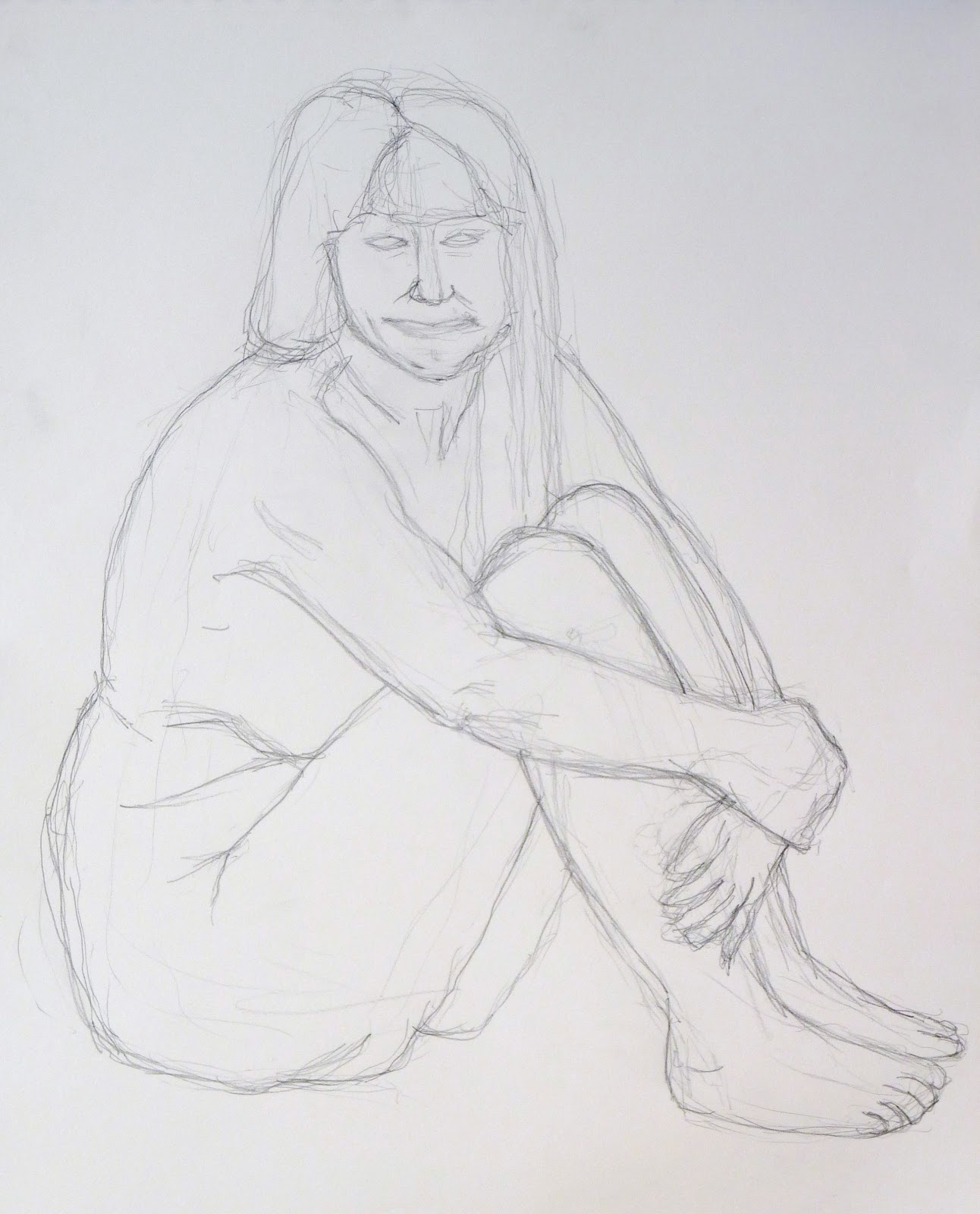
The sustained study is an extended gesture drawing, a contour drawing and a modelled drawing of the same pose. The contour drawing is drawn on tracing paper laid over the extended gesture drawing and the modelled drawing is drawn on tracing paper laid over the contour drawing (see Section 13).

Sections 14 and 15 contain a nude and a clothed study of the same pose.

One of the biggest challenges is to find a pose that Elaine can hold for 18 25-minute sessions. If you are not allowed to move, even the most seemingly comfortable position becomes torture. After about 15 minutes in this pose, Elaine would lose all felling in her right arm. To remedy this I tried to let her know when I was focusing on her feet and legs so she could move her head and arm and shake some life back into them.

Sustained Study 3 (Clothed) - Modelled Drawing
21 July 2012
Graphite Pencil on Tracing Paper
57cm x 25.5cm (22.5" x 10")

Recreating a pose at the start of each session can also be tricky. Relatively minor changes in Elaine’s or my position can dramatically alter my view. Sometimes it is difficult to determine whether I’m in a different position, Elaine is in a different position or if just one of her limbs has shifted slightly. It can be like solving a particularly tricky spatial awareness puzzle.

Sustained Study 3 - Extended Gesture Drawing
25 June 2012
Graphite Pencil on Tracing Paper
57cm x 25.5cm (22.5" x 10")

I am extremely grateful to Elaine for all the time she spends in these poses and for allowing me to post the results.

Sunday, 8 April 2012

Section 13


Sustained Study 1 - Contour Drawing
18 March 2012
Graphite Pencil on Tracing Paper
42cm x 51cm (16.5" x 20")

Yesterday I finished Section 13 of the Natural Way to Draw.

Section 13 is a milestone:
  • It is the halfway point
  • It pulls some of the threads of the course together into a single exercise (the sustained study)
  • It introduces the first exercise (the extended gesture study) that puts an emphasis on accurately drawing the proportions of the subject

The extended gesture study is a half hour exercise. It beings with a normal gesture drawing (see Gesture Drawing). You then make the drawing more accurate by looking for alignments, measuring angles and relative dimensions. You can even erase lines if the drawing becomes confusing. The one stipulation is not to allow this analytical thinking to impose rigidity on to the drawing. You have to keep returning to the spirit of the gesture and draw what the subject is doing.

The sustained study is drawn in four 1-hour sessions. It starts with an extended gesture drawing. You then put a piece of tracing paper over the gesture drawing and make a contour drawing. The instructions for the contour drawing are the same as for the original exercise (see Contour Drawing) - you have to imagine a physical contact with the subject and only draw when you are looking at the subject. The difference is you can look at the paper more often and use the gesture drawing to help locate your position on the paper.

Sustained Study 1 - Extended Gesture Drawing
11 March 2012
Graphite Pencil on Paper
42cm x 51cm (16.5" x 20")

You then remove the gesture drawing, cover the contour drawing with another sheet of tracing paper and make a modelled drawing in pencil. The instructions are largely the same as for the earlier modelled drawings (see Modelled Drawing) with one important exception. In the original exercise, the lightest parts of the drawing are the parts of the subject that are closest to you. In the sustained study, the lightest parts of the drawing are the lightest parts of the subject.

Sustained Study 1 - Modelled Drawing
31 March 2012
Graphite Pencil on Tracing Paper
42cm x 51cm (16.5" x 20")

I am immensely grateful to Elaine for all the time she spends posing and for allowing me to post these pictures. The modelled drawing is particularly unflattering, but it is an important measure of my progress at the mid point of the course. I’ve come a long way, but there is still a long way to travel.


Sunday, 1 April 2012

Holiday Sketch

Relaxing
25 March 2012
Water-soluble Pencil, Ink and Watercolour on Paper
25.5cm x 13cm (10" x 5")

On Tuesday, Elaine and I returned from an incredible holiday in the Maldives. We took a week off from the Natural Way to Draw, which made the break even more relaxing.

I kept up with the Daily Composition exercise and somehow I found time to draw Elaine reclining on a sun lounger.

This drawing is loosely based on the Extended Gesture Study and the Sustained Study from Section 13 of the Natural Way to Draw.

The Sustained Study brings together gesture drawing, contour drawing and modelled drawing. It uses tracing paper to overlay the different techniques. In this picture, I have used all three techniques on a single piece of paper.

I started by drawing an extended gesture study in water-soluble pencil. I followed this up with a contour drawing in ink and then some modelling with the water-soluble pencils.

I used a wet paintbrush to blend and soften the pencil lines. When this was dry, I finished the sketch by adding some watercolour.

This was an interesting experiment and I plan to do some more sketching using this technique.

Next weekend, I will write a more detailed post about the Extended Gesture Study and the Sustained Study.