Sunday, 17 March 2013

Not Still Life

Coconut Palm
Watercolour and Ink on Paper
14cm x 28cm (5.5" x 11")

Maggie Latham's tutorials on Ink and Wash were the inspiration for this picture.

I’ve not had the time to follow all the exercises, but they are interesting reading and I am experimenting with some of Maggie’s suggestions.

The picture is completely different to my previous ink and wash drawings (see  Ye Old Dog & Partridge and Holiday Sketch).

For this study, I drew the palm with an old sharpened twig and applied the watercolour washes with a dainty decorating brush that Elaine gave me for Christmas.

My Tools

I had not intended to post the drawing. My plan was to present a picture from yesterday’s gathering of the Shelford Group of Artists, but I didn’t finish anything. The subject for the day was Still Life and I spent most of the day drawing.

Hyacinths (Work In Progress)
Watercolour on Paper
25cm x 34cm (10" x 13")

Who would have guessed that bottles and flowers could be so complicated? Why didn’t they tell me?

Sunday, 10 March 2013

Modelling the Straight and Curve


One Leg Hanging
Modelling the Straight and Curve (10-Minute Pose)
9 March 2013
Lithograph Crayon on Paper
20.5cm x 38cm (8" x 15")

Modelling the Straight and Curve is a continuation of the Straight and Curved Lines exercise from the Natural Way to Draw.

The study is drawn with a lithograph crayon, which was the main modelling tool in the early exercises, but I don’t think I’ve touched one in over a year.

The exercise begins as a gesture drawing using straight and curved lines and continues into a stylised form of modelling.

Kimon Nicolaides does not provide much guidance for how to model in this exercise. He says it is important for the drawing to develop from the student’s feeling and understanding for the pose.

The objectives are to emphasize the form and to create a well-balanced design – which I interpret to mean a pleasing and approximately equal split of straight and curved lines.

Crawling Along
Modelling the Straight and Curve (5-Minute Pose)
9 March 2013
Lithograph Crayon on Paper
23cm x 24cm (9" x 9.5")

 It would be easy to devise a method for modelling in this exercise and to apply it to all poses, but Nicolaides stresses this is not the point. He has a wonderful turn of phrase - “This should be no cheap imitation arrived at by conscious distortion, but an effort to comprehend the gesture in a fresh way”.

Yesterday was an important milestone in Elaine and my progress through the book. We passed the 90% post. The end is in sight.

Elaine didn’t have a clue  what she was letting herself in for when I nonchalantly asked if she would pose for me. I am eternally grateful to her. (I don't know why I've drawn her in the Pope's hat in the second picture)

Sunday, 3 March 2013

Predominating Shape

Leaning For 5 Minutes
Predominating Shape (5-Minute Pose)
19 February 2013
Graphite Pencil on Paper
35.5cm x 28cm (14" x 11")

The Predominating Shape exercise from Section 23 of the Natural Way to Draw is a gesture study based on 1 and 5 minute poses. It is a variation of the Straight and Curved Lines exercise. Instead of looking for one straight or curved line that runs through the entire figure, you look for a predominating two-dimensional shape. The shape may encapsulate the whole figure or an important part of the pose. The predominating shape does not have to be a perfect geometrical shape, but I think it has to be a relatively simple shape.

After you have identified the predominating shape, you continue in the same way as in the Straight and Curved lines exercise to add complimentary straight and curved lines. The exercise is performed at the same time as an ordinary gesture drawing and each feeds from the other. The instructions are not clear, but I’m pretty sure the intention is they are drawn on top of each other.

Leaning For 1 Minute
Predominating Shape (1-Minute Pose)
19 February 2013
Graphite Pencil on Paper
38cm x 26.5cm (15" x 10.5")

Unintentionally, Elaine and I repeated one of the poses in the session on the 19th of February. This provides a comparison of a 1-minute and a 5-minute study of virtually the same pose. In both poses Elaine has her back to us. In the 5-minute pose she is looking straight ahead. In the 1-minute pose she is looking to her right and is showing us slightly less of her back. It’s interesting (well it is to me) that I chose different predominating shapes for the drawings.

Lying On One Side
Predominating Shape (5-Minute Pose)
19 February 2013
Graphite Pencil on Paper
38cm x 20cm (15" x 8")

The predominating shape is a helpful tool in identifying alignments and relative proportions. This isn’t the main purpose of the exercise, but it's a feature I will use to improve the accuracy of my extended gesture studies (see Section 13). In Lying on One Side, the predominating skewed rectangle emphasised the alignment between Elaine’s head and knee. It also helped me to realise I had misjudged the length of her torso. I didn’t have time to correct it in this drawing, but in a longer study I would.

Cross Legged
Predominating Shape (1-Minute Pose)
19 February 2013
Graphite Pencil on Paper
27cm x 34cm (10.5" x 13.5")

I’m not sure what the plague beak is all about in the cross legged pose. It is not a fancy mask or false beard. I suspect it is the neckline on Elaine’s top and I was emphasising where Elaine’s neck started in relation to the predominating shape.

Sunday, 24 February 2013

The Walk to Colton Fishacre

The Walk to Colton Fishacre
Watercolour on Paper
24cm x 34cm (9.5" x 13.5")

This is a view from the coastal path between Dartmouth and Colton Fishacre.

It is my favourite short coastal walk. It’s got a bit of everything:

  • Ferry rides to start and finish
  • Views like this
  • Lots of flora and fauna
  • An old coastal defence complex
  • A National Trust house and gardens (Colton Fishacre) with toilets (for Elaine) and an excellent tearoom
  • A shorter inland route back that makes a nice circuit
  • Good pubs at the finish
  • Plenty of up and down (so you feel like you’ve earned your tearoom and pub stops)
Unfortunately, I don’t know exactly what we are looking at. My best guess is the bay between the foreground and the rocky headland is Old Mill Bay and the crinkly bit on the headland is Kelly’s Cove, but I might be wrong.

One of my resolutions for this year is to be more conscientious about recording where I sketch and take photographs. Elaine bought me a camera with a GPS for Christmas, which will help, but I’m going to write notes as well.

Creating the grassy edge on the foreground was one of the trickiest bits of this picture because I wanted the edge to be light against the darkest part of the sea. I considered a number of options before deciding to create the grass by scratching away the dry paint with a scalpel (see Scratching and Scraping).

Sunday, 17 February 2013

Limited Palette

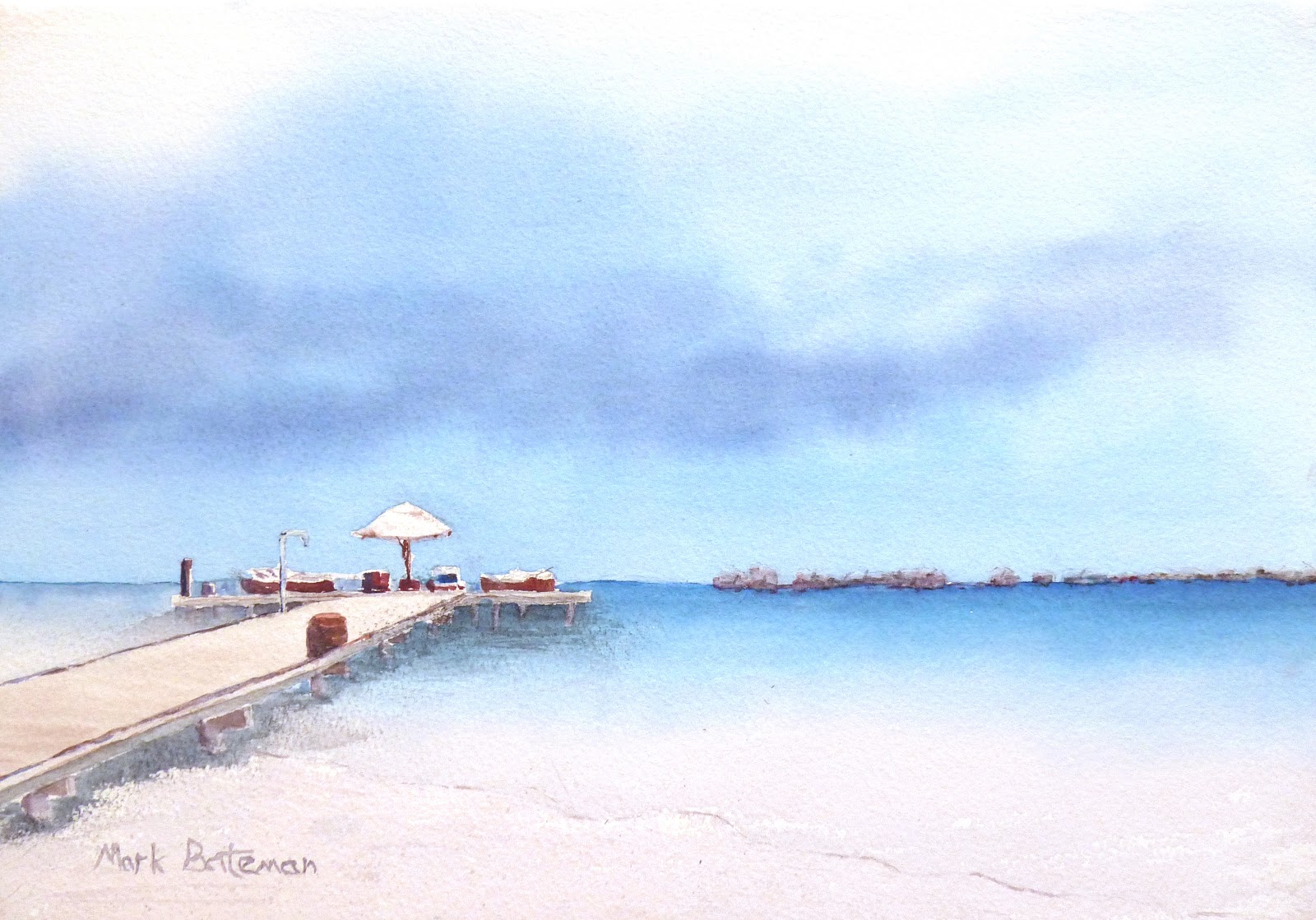
Storm Clouds Over the Maldives
Watercolour on Paper
34cm x 24cm (13.5" x 9.5")

Yesterday was my first painting day with the Shelford Group of Artists of 2013.

Tony Slater's topic for the day was painting with a limited palette. This was the same topic as one of the first Shelford painting days I attended - back in April 2011 (see Sarah Jane).

I took the opportunity to knuckle down and paint a subject I’ve been messing around with for the best part of a year.

In March of last year, Elaine and I had an incredible holiday in the Maldives (see Holiday Sketch). While we were there, I took a photo of a spectacular storm approaching the islands.

Since we got home, I've tried to paint more than 20 versions of the sky, but I’ve never got it right. Most of my attempts suffered from being too moody and threatening. Yesterday, I realised that I’d been painting British storm clouds. The atmosphere I wanted to recreate was “yes, there’s a storm coming, but we're sitting on the beach drinking cocktails.”

Tony suggested we select two or three harmonious colours. Initially, I picked a warm colour (Burnt Sienna) and a cool colour (Winsor Blue (Green Shade)). I couldn’t mix a good colour for the cloud shadows from them, so I added Permanent Rose which also helped to spice up some of the details on the platform.

Sunday, 10 February 2013

More Exercises in Oil

Curled Up - Half-hour Study
2 February 2013
Oil Colour on Paper
59cm x 31cm (23.25" x 12.25")

The first exercises in oil were a challenge (see Exercises in Black and White Oil Color), but now I am beginning to understand the attraction of oil paints.

I started to enjoy the exercises once I embraced the medium and stopped trying to use the brush like a pencil. This is the same lesson I had to learn for gesture drawing with the Conté crayons (see More Gestures in Black and White).

Standing Hamstring Stretch - Gesture Drawing
2 February 2013
Oil Colour on Paper
14cm x 36cm (5.5" x 14")

The studies from the original post were drawn with the quarter inch brush. Now, I am making more use of the three quarter inch brush, particularly in the shorter studies. Instead of trying to scribble (which is difficult with the limited amount of paint in the bristle brushes), I am using the three quarter inch brush to make gestural marks.

Sustained Study - Section 22 - Modelled Drawing
7 February 2013
Oil Colour on Paper
27.5cm x 51cm (10.75" x 20")

The modelled drawing is both difficult and enjoyable. The instructions are to model in the same way as with the Conté crayons - apply less pressure with the black crayon when a surface in the dark turns towards the light and less pressure with the white crayon when a surface in the light turns away from the light. This works well with the crayons. With paint, there is a tendency for it to build up during the exercise and for some of the subtlety in the initial modelling to be lost. I am not too concerned about this because Kimon Nicolaides' advice is not to worry about overworking the modelling exercises. The purpose of the exercises is to experience the sensation of modelling as though you have touched every part of the form - not to create pretty oil paintings.

Sunday, 3 February 2013

Sheep

Lost Sheep
Watercolour on Paper
14cm x 28cm (5.5" x 11")

Sheep are inquisitive animals. If you stop to take a photo or draw them, they all turn to look at you. Perhaps they are vain or perhaps they are part of a neighbourhood watch organisation that keeps track of undesirables in the countryside.

The cows in Waiting for Rain - Summer 2012 were fun to paint. I've been intending to paint more animals, but have only just got around to it.

The sky is based on the wash I practiced as sky wash 10 (see Sky Washes 8, 9 and 10). It was good to have the opportunity to incorporate it in to a picture.

We're Watching You
I'll Remember Your Face
You're Not From Around Here