Monday, 22 April 2019

Keys to Drawing with Imagination – Creating Destruction

Brown Bag Lunch
Creating Destruction
Keys to Drawing with Imagination
Graphite Pencil on Paper
Stillman & Birn Alpha Series Sketchbook
14.0cm x 20.3cm (5.5" x 8.0")

Exercise 9 of Keys to Drawing with Imagination is about drawing things that are crumpled, dented or crushed. Bert observes there is something aesthetically pleasing about the partially destroyed.

This is my third go at drawing a crumpled bag. I seem to have forgotten everything I knew about drawing and rendering shadow shapes. I will persevere with this sort of drawing with pencil and pen over the next few weeks. I need to get back into the practice of first analysing and outlining the shadow pattern and then becoming absorbed in rendering it.

Sunday, 7 April 2019

Drawing and Painting the Landscape – Partial Peek

Coaley Peak
Partial Peek - Drawing and Painting the Landscape
Ink and Gouache
Stillman & Birn Alpha Series Sketchbook
30.5cm x 21.5cm (12" x 8.5")

Partial peek is the subject of Lesson 4 in Drawing and Painting the Landscape by Philip Tyler . It is the next step after blind drawing (see Drawing and Painting the Landscape - Blind Drawing). The aim is still to spend more time looking at the landscape then your sketchbook. You blind draw as much as possible, but take occasional peeks at the paper to ensure your lines are not too far out of whack.

Clouds in the Valley and Ivy Clad Oak Trees
Partial Peek - Drawing and Painting the Landscape
Ink and Gouache
Stillman & Birn Alpha Series Sketchbook
21.5cm x 30.5cm (8.5" x 12")


Philip observes that some elements of the landscape lend themselves more to blind drawing than others - he suggests trees and rolling hills. Liz Steel makes a similar observation in her SketchingNow Foundations course.
Draw the foliage loosely, almost blind without worrying if the tree gets out of control a little.
I think blind drawing works best when a descriptive edge is more important than pinpoint accuracy.

Otter Estuary and Mon & Brec
Partial Peek - Drawing and Painting the Landscape
Ink and Gouache
Stillman & Birn Alpha Series Sketchbook
21.5cm x 30.5cm (8.5" x 12")

I drew a few partial peeks from photographs and one in situ at Coaley Peak - this is just along the Cotswold Way from Selsley Common (where the sketchbook was blown out of my hand during the Blind Drawing exercise). Coaley Peak is normally even windier than Selsley common, but this time the weather was kinder.

Sunday, 24 March 2019

Expressive Drawing – Rhythm

Rhythmic Drawing with Several Motifs
Expressive Drawing - Chapter 7 - Build 3
Digital

In Chapter 7 of Expressive Drawing, Steven Aimone discusses Rhythm. He observes there is a rhythm in all living things and suggests if a drawing displays rhythm, it can be experienced as being about nature or life itself. I agree that there is something primal about a drawing with a strong rhythmic component.

Rhythmic Repetition
Expressive Drawing - Chapter 7 - Play 1
Graphite on Paper
84.1cm x 20cm (33.1" x 8")

The initial play exercises concern creating long thin drawings based on the rhythmic repetition of vertical lines.

Horizontal Rhythm of a Vertical Line Bar Motif
Expressive Drawing - Chapter 7 - Build 1
Acrylic on Paper
84.1cm x 59.4cm (33.1" x 23.4")

The first build exercise is also about the rhythmic repetition of vertical lines. The instructions for the exercise are like those for previous exercises - you add elements to the drawing and remove anything you don’t like by erasing or obscuring it.

I had a major loss of mojo during this exercise. The drawing quickly reached a point where both Elaine and I were enthusiastic about it. Elaine even talked about framing it. I decided to do one more thing, which spoilt the composition and then spent weeks adding bits on and covering bits up - never finding a pattern I enjoyed. Part of the problem is once lines have been erased or obscured, the drawing begins to look overworked. The white acrylic I use intensifies the problem because it's not a pure white - it has a slight creamy yellow cast. My loss of confidence and enthusiasm was also due to a lack of time for drawing and painting.

Rhythmic Drawing with Several Motifs
Expressive Drawing - Chapter 7 - Build 3
Charcoal on Paper
59.4cm x 84.1cm (23.4" x 33.1")

I began to get things back together on the final build exercise - creating a rhythmic drawing with several motifs. I wanted to draw it again and refine it. For a change, I decided to do this in GIMP a free alternative to Photoshop.

Sunday, 10 March 2019

Drawing and Painting the Landscape – Blind Drawing


Otter Estuary
Blind Drawing
Drawing and Painting the Landscape
February 2019
Ink
Stillman & Birn Alpha Series Sketchbook
20cm x 11cm (8" x 4.25")

Lesson 3 of Drawing and Painting the Landscape by Philip Tyler is Blind Drawing (a.k.a. Blind Contour Drawing). Most drawing courses and books include blind drawing in one form or another. See the contour drawing label for posts about contour drawing and blind drawing from:

  • The Natural Way to Draw
  • Keys to Drawing
  • Liz Steel’s SketchingNow Foundations course
  • Adebanji Alade’s Inspired to Sketch blog

The aim of the exercise is to study the subject intently. You draw while looking at the subject, you don't look at the paper until the drawing is complete. I particularly like Kimon Nicolaїdes instructions from The Natural Way to Draw:
Imagine that your pencil point is touching the model instead of the paper. Without taking your eyes off the model, wait until you are convinced that the pencil is touching that point on the model upon which your eyes are fastened. Then move your eyes slowly along the contour of the model and move the pencil slowly along the paper. As you do this, keep the conviction that the pencil point is actually touching the contour. Be guided more by the sense of touch than by sight.

Langdale Hills
Blind Drawing
Drawing and Painting the Landscape
February 2019
Graphite Pencil
Stillman & Birn Alpha Series Sketchbook
29cm x 15cm (11.5" x 6")

Philip Tyler recommends the exercise as a technique for warming up:
To find a way of getting into the landscape to discover how it might be drawn.
I drew a few blind drawings from photographs and one in situ on Selsley common. The common is on the edge of the Cotswolds with views over the Severn estuary stretching as far as the Brecon Beacons and the Malvern Hills. It is almost always blustery on the common, probably because the valley acts like a wind tunnel. Elaine and I were there walking with Doris on a particularly windy day. I took a few minutes to sit on a bench and draw the view of Pen Hill. The exercise reached a natural conclusion when the wind abruptly ripped the sketchbook out of my hands and deposited it a few feet away.

Pen Hill from Selsley Common
Blind Drawing
Drawing and Painting the Landscape
February 2019
Graphite Pencil
Stillman & Birn Alpha Series Sketchbook
20cm x 18cm (8" x 7")

I enjoy blind drawing and always get enthralled by the exercise, but my drawings never look anything like the thing the subject. While drawing Pen Hill I realised part of the problem is I normally place the paper to my side - outside of my field of vision. The contortion on my arm makes it difficult for my hand to track accurately; which results in a wonky sketch. It doesn't really matter because the objective of the exercise is to study the subject intently - not to produce a master drawing, but I would still prefer the results to be slightly more accurate. Philip suggests using the cover of the sketchbook over your hand, so that you cannot accidentally look at the drawing. Something I will do from now on.

Sunday, 17 February 2019

Valentine’s Day Card Doodle


Happy Valentine’s Day Elaine

Hearts are difficult - to draw. They are all curves and changes of direction. It is easy to hesitate while drawing them and this results in scrappy looking lines. My trick is to use a brush pen on rice paper. This combination gives a pleasantly blotchy line – a bit of hesitancy is just lost in the noise.

I used Winsor and Newton alcohol based ProMarkers to colour the design and lettering. They also spread unpredictably on rice paper – which means they can be blamed for any tendency to stray outside the lines.

The overall effect is controlled untidiness (a phrase borrowed from John Lovett).

The pattern was inspired by an exercise on rhythm from Expressive Drawing by Steven Aimone. I sketched it out, then refined it by tracing it and tweaking it multiple times using an LED light box.

I drew the motif and the letters on separate pieces of rice paper before combining them in GIMP (GNU Image Manipulation Program - a free alternative to Photoshop) and uploading onto a Moonpig card.

Happy Valentine’s Day Elaine.

Sunday, 3 February 2019

Drawing and Painting the Landscape – Revealed Landscape

Walking the Mon & Brec Canal (May 2018)
Revealed Landscape
Drawing and Painting the Landscape
January 2019
Graphite Pencil
Stillman & Birn Alpha Series Sketchbook
14cm x 11cm (5.5" x 4.25")

Lesson 2 of Drawing and Painting the Landscape by Philip Tyler is about a technique to reduce inaccuracy in landscape drawings - perhaps (more subtly) it is about studying the landscape closely and understanding how it is arranged. The title Revealed Landscape describes the technique - you obscure most of a source photograph and draw the small “revealed” section.

Revealed Landscape
Drawing and Painting the Landscape
January 2019
Graphite Pencil
Stillman & Birn Alpha Series Sketchbook
21.5cm x 30.5cm (8.5" x 12")

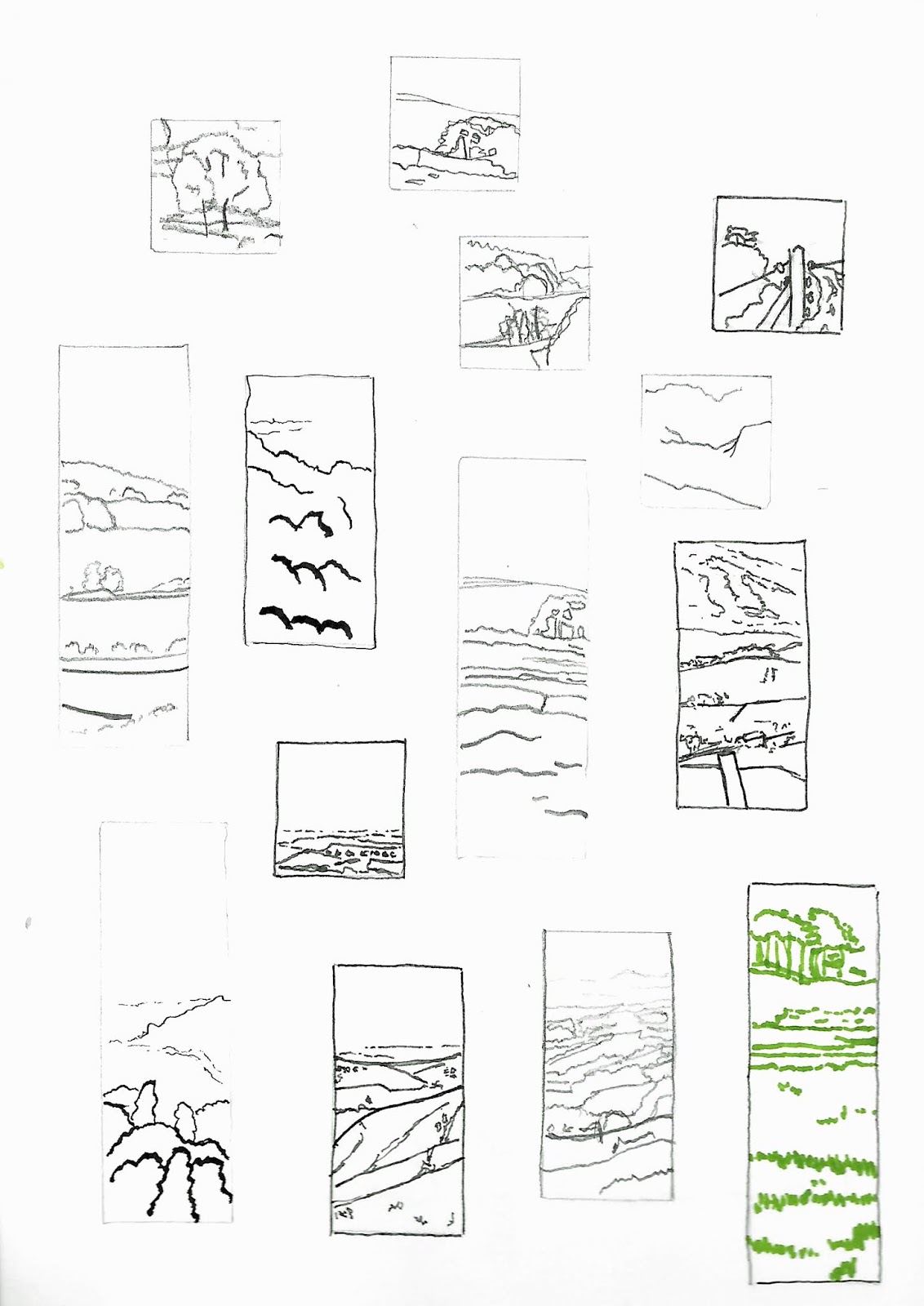
In the first assignment you use a piece of paper to obscure everything bellow the horizon, draw the horizon, move the paper down a small amount, draw the newly revealed section of landscape, and continue down the page.

After I finished two of these drawings, I added some shading to them. In retrospect this was probably cheating because the lesson is part of a chapter called “Linear Drawing”

Basic Proportion
Drawing and Painting the Landscape
January 2019
Various Media
Stillman & Birn Alpha Series Sketchbook
21.5cm x 30.5cm (8.5" x 12")

The second assignment is to cut a square or rectangular window in a piece of card, place this over a photograph, and draw what you see through the window into a box with the same proportions. Comparing the position and size of the lines and shapes relative to the long and short sides of the rectangle helps you to recognise their size and position in the overall composition.

Basic Proportion
Drawing and Painting the Landscape
January 2019
Various Media
Stillman & Birn Alpha Series Sketchbook
21.5cm x 30.5cm (8.5" x 12")

I used photos of our neighbourhood and from recent holidays as source material for these pictures. I'm looking forward to drawing directly from the landscape in the following exercises.

Sunday, 13 January 2019

Drawing and Painting the Landscape - The Evocation of Memory

Invented Landscape
Drawing and Painting the Landscape
January 2019
Various Media
Stillman & Birn Alpha Series Sketchbook
7.5cm x 11.5cm (3" x 4.5")

Elaine gave me Drawing and Painting the Landscape by Philip Tyler as a Christmas present. The subtitle of the book gives a clue to its structure "A course of 50 lessons".

The first lesson is called "The Evocation of Memory". It starts with a discussion of how photographs of landscapes can take us back to a place and a moment in time. A familiar landscape is more than a view - it is a collection of memories.

The lesson then goes in the opposite direction to show how little is needed to give a sense of landscape.

Invented Landscapes - 1
Drawing and Painting the Landscape
January 2019
Various Media
Stillman & Birn Alpha Series Sketchbook
21.5cm x 30.5cm (8.5" x 12")

The first exercise involve placing a horizontal horizon line somewhere in a rectangle then drawing more lines moving down the page. Initially, drawing lightly with the lines close together. The lines get darker and further apart as they progress down the rectangle. In the first exercise, the lines do not have to be perfectly straight, but any deviations should be relatively small. In the second exercise, the lines can develop lumps and bumps of increasing size as they get further from the horizon.

Invented Landscapes - 3
Drawing and Painting the Landscape
January 2019
Various Media
Stillman & Birn Alpha Series Sketchbook
21.5cm x 30.5cm (8.5" x 12")

In the third exercise, the lines are drawn on top of torn coloured paper . The paper is initially torn neatly and then more roughly.

Invented Landscapes - 3
Drawing and Painting the Landscape
January 2019
Various Media
Stillman & Birn Alpha Series Sketchbook
21.5cm x 30.5cm (8.5" x 12")

Many of these drawings look like landscapes to me, but Elaine is less convinced. The ones she finds most persuasive are the ones with low horizon lines.

Invented Landscapes - 3
Drawing and Painting the Landscape
January 2019
Various Media
Stillman & Birn Alpha Series Sketchbook
21.5cm x 30.5cm (8.5" x 12")

The picture quality on this post is not up to the usual standard. I’ve bought a new sketchbook for the course and it is slightly too big for our scanner. I’m experimenting with different approaches, but I haven’t found the right solution yet.

My intention to draw for 15 minutes a day in 2019 has already fallen by the wayside, but sometimes plans must change to accommodate events. I'm drawing most days, and still feel as though I am sticking to the spirit of the challenge.